
NEWS
June 3rd, 2026
Clement offers a beautiful range of conservation rooflights. We have eight standard sizes which are available from stock in either a slate or tile profile, or we can manufacture bespoke rooflights to your individual designs.
Below we answer some of your most common questions when it comes to our range of rooflights:
A conservation rooflight is a type of window which is installed into the roof of Listed Buildings, properties in Conservation Areas or other heritage situations. Treasured for their traditional appearance and superior performance, Clement Conservation Rooflights are modern reproductions of an original Victorian design and are often specified by Architects and Conservation Officers. Clement’s rooflights are competitively priced, and the standard range is available from stock within a matter of days.
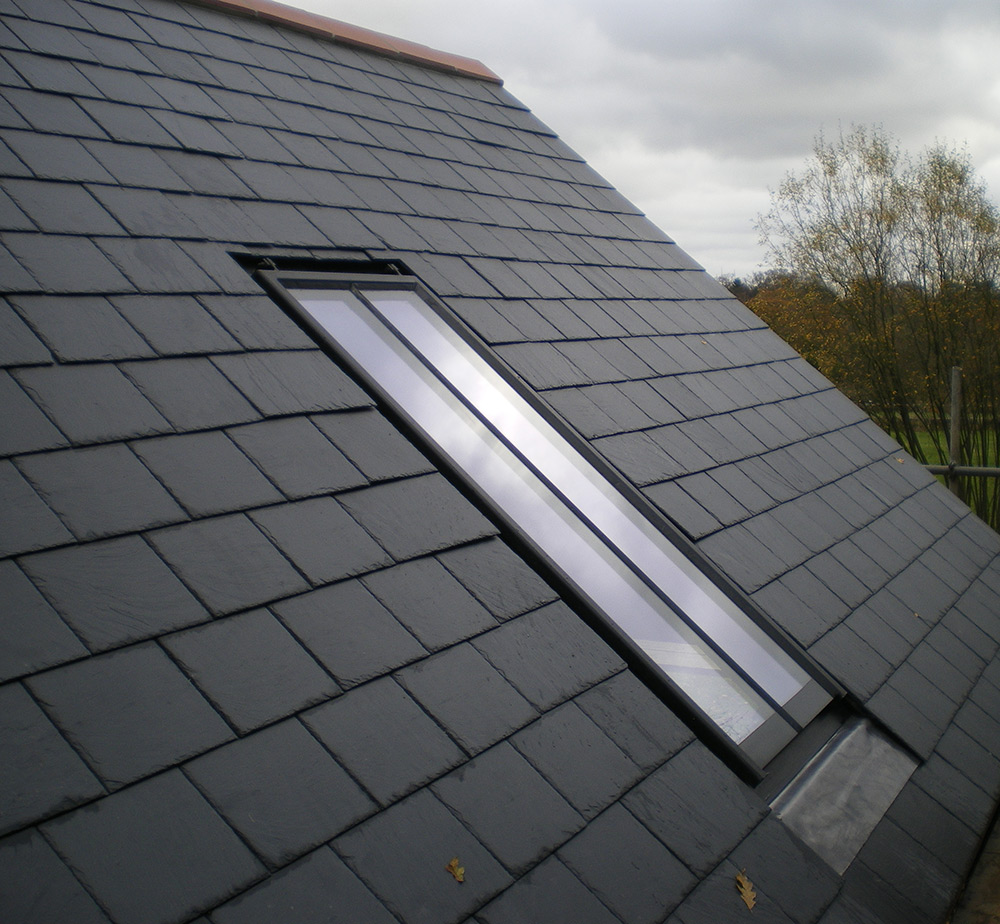
This is why Clement offers a lower profile slate conservation rooflight…it achieves the perfect fit!
Clement is the only company to offer two different rooflight profiles, one for a thinner material such as slate and one for thicker materials like tile. Of course, because these materials have completely different depths, it makes sense that one size does not fit all when it comes to rooflights. By choosing the correct profile for your roof type you are ensuring the rooflights will lie flush with the roofline, rather than jutting out above the top of the roof. Previous clients have successfully installed these skylights into zinc and thatch roofs too.
Yes, a rooflight is a roof window, also known as a skylight. While some people define each separately, the terms are usually used interchangeably. Rooflights are often installed into loft spaces or extensions to introduce more light into the space. Clement’s conservation rooflights are rated “A+” for energy performance by the BFRC and will help to save money on energy bills.
Choosing the right size conservation rooflight will really enhance a space, letting in lots of light and improving energy efficiency. One should always aim to install a rooflight that is appropriate to the size of the room. Clement Conservation Rooflights are particularly slim framed and for the standard range, several dimensions are quoted: the overall external size, which is the size of the rooflight as it sits on top of the roof and as viewed from the outside; the clear glass (internal) size, which is the size of the glass viewed looking from the inside out when the rooflight is fully fitted; and, the between the rafters size, which is the size between the rafters that the rooflight is fitted into.
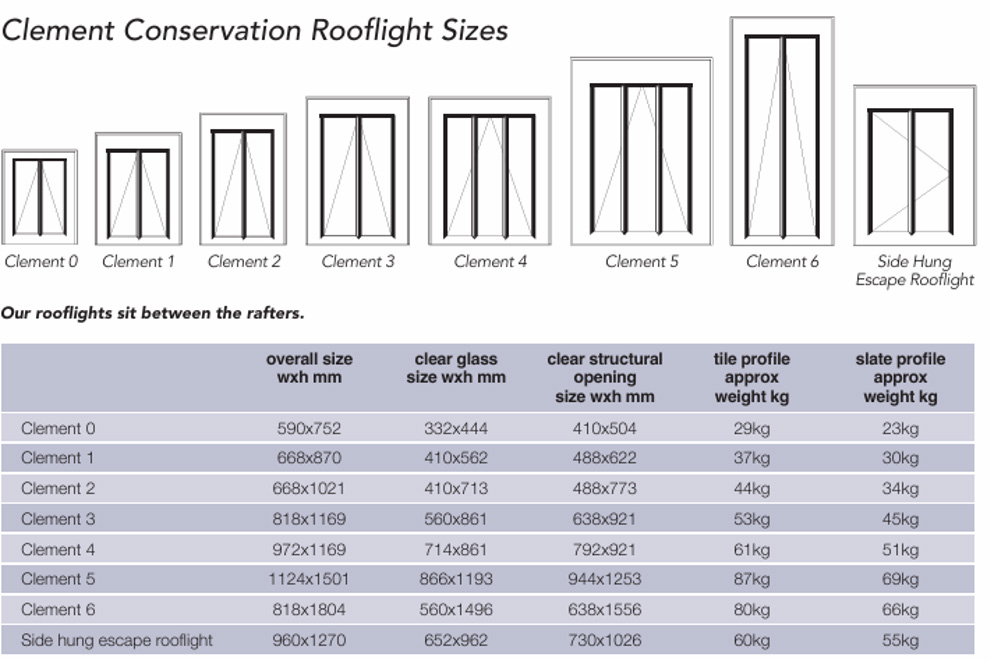
The Clement Conservation Rooflights range available from stock.
The largest conservation roof window in Clement’s standard range is the Clement 5. The overall external size of this top hung rooflight is 1124 mm (w) x 1501 mm (h) and the weight of this varies depending on whether it is a tile profile rooflight or a slate profile rooflight. The Clement 6 rooflight offers a longer option measuring 818 mm (w) x 1804 mm (h). Clement also manufactures made to measure conservation rooflights which are crafted to the specific size requirements of the project. Ultimately, there is a limit to how big a rooflight can be, but it depends on the precise parameters of the specific project.
The recommended roof pitch for all Clement Conservation Rooflights is 20°- 70°.
While work to the roof of a house that does not materially affect its external appearance will usually not require planning permission, there are additional considerations if the property is listed or located in a Conservation Area. It is always worth consulting the relevant Conservation Officer who will be able to provide advice. Clement Conservation Rooflights are designed with traditional properties in mind, and they are often specified by Conservation Officers for Listed Buildings and heritage properties, including those located in Conservation Areas. Their traditional good looks, flush fit and exceptional energy performance mean they are a great addition to a building.
Approval under Building Regulations will usually be needed to install a conservation rooflight in a roof because the roof structure will generally need to be altered to create the opening, the roof will need to be able to carry the weight of the rooflight and consideration will need to be given to insulation and fire performance. Planning permission will also be required if the property is listed or located in a Conservation Area. Clement Conservation Rooflights are often specified for heritage situations. They have been awarded an “A+” Window Energy Rating by the BFRC and are fitted with a revolutionary T-bar system which makes them less prone to leaks and drafts. Clement can also offer side hung/escape rooflights for projects where these are required. For further information about Building Regulations approval, we recommend contacting your Local Planning Authority.
Clement offers a wide selection of accessories for your new rooflight. You can view them all here. Each rooflight requires a winder to operate it manually and these are available in a brass or a chrome finish. Choose from hand or thumb winders for rooflights which are within reach, or pole winders and winding cranks for out of reach rooflights. Blinds and electrical openers are also available to fit our rooflights. Get in touch for more information.
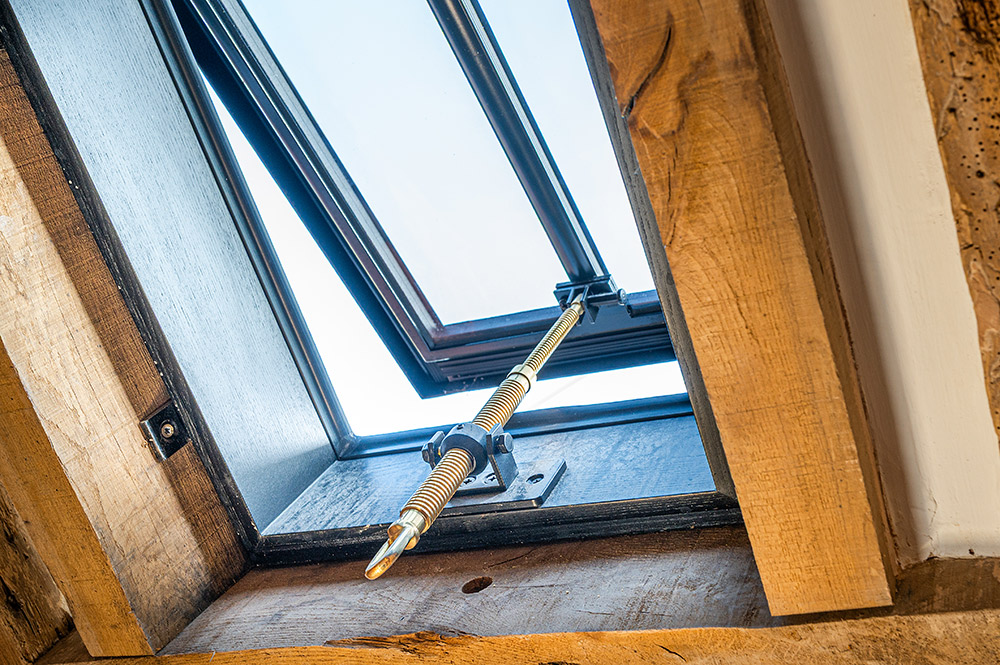
A tile profile Clement Conservation Rooflight with a brass pole winder.
Yes, you can link Clement Conservation Rooflights together and our clients often do this to create a larger area of light. To link rooflights, a rafter of at least 180mm will be required between each rooflight. Ask one of our sales team for more information.
We do all we can to keep our rooflights as competitively priced as possible. For costing information about our standard range, please take a look at our Size & Price Guide or speak to a member of our sales team. The price of made to measure options obviously varies depending on the particular requirements of the project.
You can send us information about your project via our contact form, or call us now on 01428 643393. We look forward to hearing about your project.

superb steel windows, doors and conservation rooflights